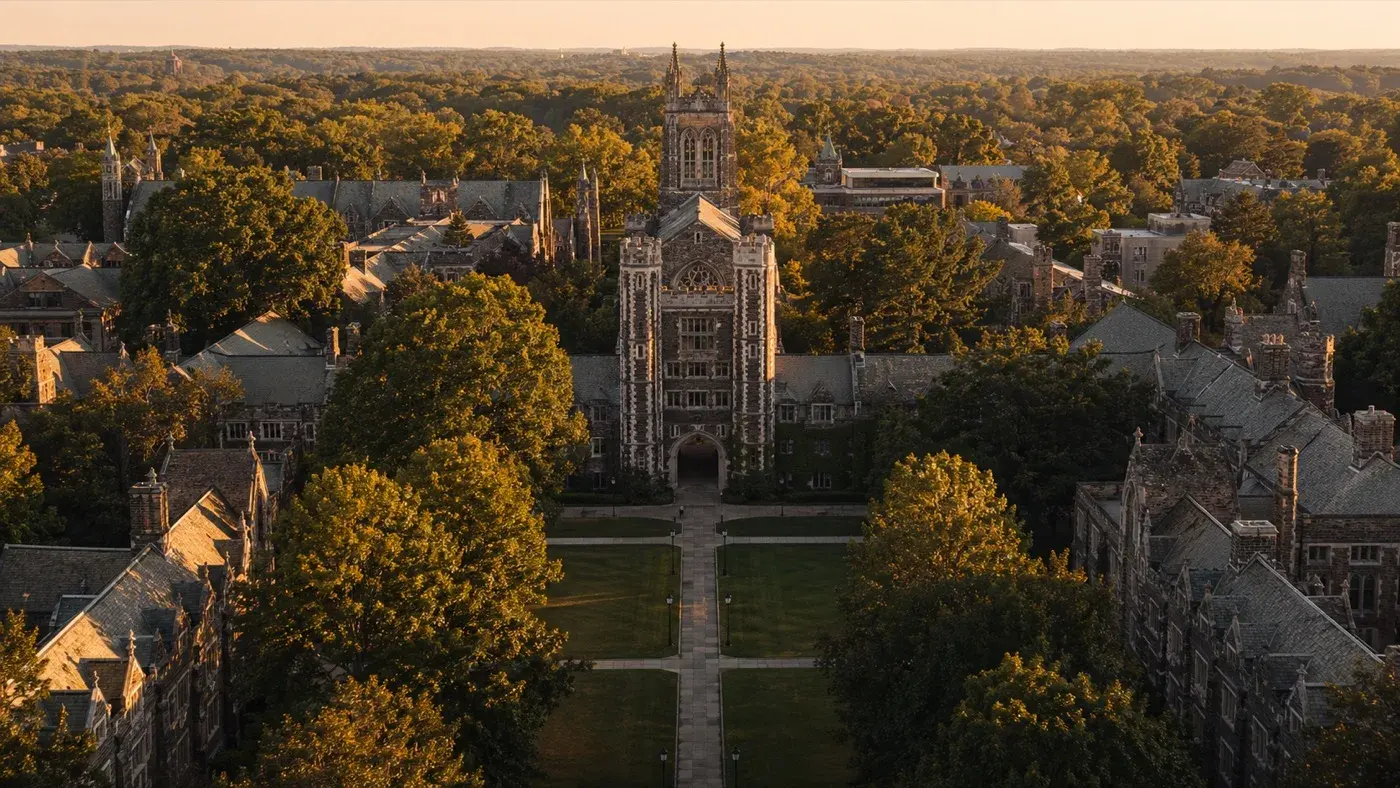

Princeton University
Seven residential colleges on a 3,500-acre campus between NYC and Philadelphia.
Acceptance rate
4.6%
SAT (mid 50%)
1510–1580
Avg net price
$6,128
after aid
Next deadline
Nov 1
REA
Testing
Optional
2026 cycle
Sources: the U.S. Department of Education (2024), and the Princeton University admissions site.
Your chances
How hard is it to get in?
Princeton University admitted 4.6% of applicants in its most recent reported class. That’s one of the lowest rates in the country. It’s a reach for every applicant, no matter how strong.
Here’s where admitted students landed on tests. The middle 50% score 1510–1580 on the SAT and 34–35 on the ACT. Scores at or above that band keep you in contention. They don’t decide it.
The real question isn’t your odds. It’s your move. That’s where Spike comes in. It reads your profile against what Princeton University actually rewards, then tells you what to do next.
What they value
Built around independent research
Every senior completes an original thesis with one-on-one faculty mentorship.
Distribution across 7 areas; no fixed core.
- 100% write a thesisOriginal research · Faculty advisor · Junior paper first
- Engineers read the classics7+ humanities courses required · Human-centered
- Economics → finance & techTop concentration · Policy & operations research
Verified from princeton.edu and admission.princeton.edu.
Applying
Here’s what to send, and when.
- Next deadlineNovember 1, 2026 (REA)
- Regular decisionJanuary 1, 2027
- TestingOptional (2026 cycle)
- Recommendations3 letters
- Personal essayRequired
- ApplicationCommon App
Verified from princeton.edu.
The essays
Here are the supplemental essay prompts.
The current prompts, straight from the application. They change year to year. Most guides you’ll find are a cycle behind.
As a research institution that also prides itself on its liberal arts curriculum, Princeton allows students to explore areas across the humanities and the arts, the natural sciences, and the social sciences. What academic areas most pique your curiosity, and how do the programs offered at Princeton suit your particular interests? (Please respond in 250 words or fewer.)
Up to 250 words
Please describe why you are interested in studying engineering at Princeton. Include any of your experiences in or exposure to engineering, and how you think the programs offered at the University suit your particular interests. (Please respond in 250 words or fewer.)
Up to 250 words
Princeton values community and encourages students, faculty, staff and leadership to engage in respectful conversations that can expand their perspectives and challenge their ideas and beliefs. As a prospective member of this community, reflect on how your lived experiences will impact the conversations you will have in the classroom, the dining hall or other campus spaces. What lessons have you learned in life thus far? What will your classmates learn from you? In short, how has your lived experience shaped you? (Please respond in 400-500 words.)
Up to 500 words
Princeton has a longstanding commitment to understanding our responsibility to society through service and civic engagement. How does your own story intersect with these ideals? (Please respond in 250 words or fewer.)
Up to 250 words
What is a new skill you would like to learn in college?
Up to 50 words
What brings you joy?
Up to 50 words
What song represents the soundtrack of your life at this moment?
Up to 50 words
Every prompt, with how to approach each →
Verified from princeton.edu.
Cost and aid
What will you actually pay?
The sticker price is about $84,040. That isn’t what most families pay. After need-based aid, the average net price is $6,128.
Need-blind for everyone, including international applicants — 100% of need met with grants, never loans.
Ten years after enrolling, graduates earn a median of $110,066.
Verified from princeton.edu and the U.S. Department of Education.
Academics
These are the most popular majors.
- Computer Science16% of degrees
- Economics10% of degrees
- Public Policy Analysis9% of degrees
- Operations Research6% of degrees
- History6% of degrees
- Political Science and Government4% of degrees
Popular: Computer Science · Public Policy · Economics
Campus life
Here’s the feel of the place.
“A close-knit community where independent research is the norm.”
Nearly all undergraduates live on campus; the 140-year eating-club tradition anchors social life.
Quick answers
What do people ask about Princeton University?
- Is Princeton University test-optional?
- For the 2026 application cycle, standardized testing at Princeton University is optional.
- How hard is it to get into Princeton University?
- Very hard. Princeton University admits 4.6% of applicants. The middle 50% of admitted students score 1510 to 1580 on the SAT. Treat it as a reach for every applicant.
- When is the Princeton University application deadline?
- The next deadline is November 1, 2026 (REA). Regular Decision closes January 1, 2027.
- How much does Princeton University cost?
- The list price is about $84,040. After aid, families pay $6,128 on average. Princeton University meets full demonstrated financial need.
- Is Princeton University worth it?
- Graduates earn a median of $110,066 ten years after enrolling. 97% of students graduate within six years. Value depends on your aid offer and your goals. That’s what Spike helps you weigh.
Launching soon
Ask Spike anything about Princeton University.
Spike answers from Princeton University’s own site, then helps you figure out your move.